
Sublime Plant-Based Cauliflower Steaks with Onion & Cashew Sauce
A sublime plant-based centrepiece: caramel-kissed cauliflower steaks crowned with a silky onion and cashew sauce—comforting, nourishing, and entirely dairy-free.
Ingredients
- 6 tbsp sunflower oil
- 1 large onion, thinly sliced
- 50g cashew nuts
- 1 cauliflower
- 1 red chilli, roughly chopped
- 1 tbsp tomato purée
- 1/2 tsp salt
- 1/2 tsp caster sugar
- 1 tsp garam masala
- 1/4 x 25g pack coriander
Instructions
- Heat 4 tbsp oil in a pan and add the onion and cashews. Cook over a medium heat for 10-12 minutes until golden. Transfer the cooked onion mixture to a sieve and sit over a bowl for 10 minutes to drain any excess oil, reserve both.
- Meanwhile, cut the cauliflower through the root to make 2 slices, about 1,5cm thick, from the middle of the cauliflower (save the smaller forets anc cauliflower leaves for another dish). Heat the remaining 2 tbsp oil in a large frying pan and cook the cauliflower steak over a medium heat for 6-7 minutes on each side, until golden and tender.
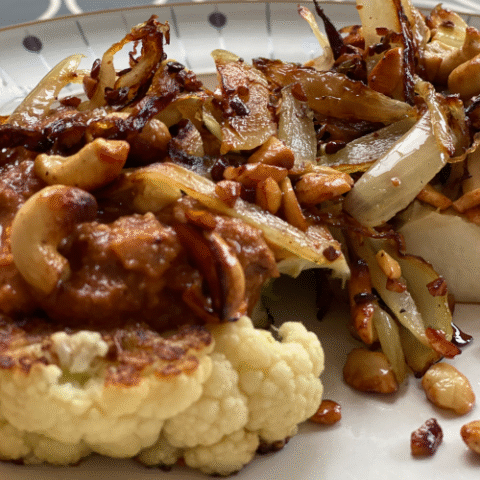
- Transfer 2/3 of the onion mixture to a blender with the chilli, tomato purée, salt, sugar, garam masala and 50ml water, plus 1tbsp of the onion oil. Whizz to a smooth purée. Serve the cauliflower steaks topped with the purée, extra onion mixture and a scattering of coriander leaves. This is great served on its own, couscous or salad.
Nutrition Information:
Yield: 2 Serving Size: 1Amount Per Serving:Calories: 912Total Fat: 72gSaturated Fat: 12gTrans Fat: 0gUnsaturated Fat: 54gCholesterol: 50mgSodium: 1783mgCarbohydrates: 45gFiber: 10gSugar: 15gProtein: 29g
Cauliflower Steaks: from coastal gardens to a global favourite
Cauliflower steaks may feel modern, but the vegetable itself has deep roots. Cauliflower belongs to the Brassica oleracea family, alongside cabbage, kale, and broccoli. It is thought to have originated from Mediterranean coastal varieties that were selectively bred for their dense, edible curd. By the 16th and 17th centuries, cauliflower had become a prized delicacy across Europe, valued for both its mild flavour and culinary versatility.
Today, cauliflower steaks have become a plant-based staple, appearing everywhere from home kitchens to restaurant menus. Slicing cauliflower into thick steaks transforms a humble vegetable into a satisfying centrepiece that holds bold sauces, herbs, and spices with ease.
If you enjoy vegetables as mains, you might also like my plant-based aubergine schnitzel, which uses a similar “meaty” technique with vegetables.
What gives cauliflower steaks their distinctive flavour
The flavour of cauliflower steaks comes from a combination of chemistry and cooking technique. Cauliflower contains glucosinolates—sulphur-bearing compounds that release aroma molecules when cut or heated. These compounds create the gentle brassica notes we associate with cauliflower.
Roasting cauliflower steaks at high, dry heat encourages Maillard reactions between natural sugars and amino acids. This produces toasted, nutty flavours and subtle sweetness, softening the vegetable’s sharper edges. Cauliflower also contains naturally occurring glutamates, which add savoury depth and explain why it works so convincingly as a meat-free main.
For a deeper dive into the science of flavour development during roasting, see this explainer from Harvard T.H. Chan School of Public Health on cooking and nutrients.
Nutrition at a glance: why cauliflower steaks nourish as well as satisfy
Cauliflower steaks are low in kilocalories yet rich in fibre, supporting digestion and helping you feel full without heaviness. A standard portion contributes vitamin C, vitamin K, folate, and small amounts of potassium—nutrients commonly found across vegetables in the Brassica family. According to the NHS 5 A Day guidance, eating a wide variety of vegetables, including cruciferous types like cauliflower, plays an important role in meeting daily fibre and micronutrient needs
Cashew nuts: creamy magic behind the sauce
Cashews originated in northeastern Brazil and spread globally through Portuguese trade routes in the 16th century, particularly to India and Mozambique. Nutritionally, cashews provide heart-friendly monounsaturated fats, plant protein, magnesium, copper, and B vitamins.
When blended, cashews form stable emulsions thanks to their fat and starch content. This makes them ideal for creating creamy sauces without dairy—one reason cashew-based sauces feature so prominently in plant-based cooking. If you’re interested in the broader nutritional profile of nuts, the British Nutrition Foundation offers a clear overview.
Why onion and cashew sauce elevate cauliflower steaks
Slow-cooked onions develop sweetness through caramelisation, building layers of savoury, malt-like flavour. Combined with creamy cashews, they form a sauce that is rich yet balanced. Spoon this over roasted cauliflower steaks and the effect is transformative: sweetness, nuttiness, savouriness, and gentle peppery notes in perfect harmony.
This flavour pairing works because it complements cauliflower rather than overpowering it—enhancing its roasted character while smoothing out brassica sharpness.
Sustainability and mindful eating
Cauliflower steaks generally carry a lower environmental footprint than animal-based mains. Cashews, while transport-intensive, are nutrient-dense, meaning smaller portions deliver substantial nourishment. Choosing ethically sourced or fair-trade cashews supports better labour practices in processing regions. For more on sustainable food choices, the FAO provides useful guidance.
The flavour take-away
These cauliflower steaks with onion and cashew sauce prove that plant-based cooking can feel indulgent, balanced, and deeply satisfying. Roasted cauliflower brings savoury depth, cashews deliver creaminess without dairy, and onions tie everything together with gentle sweetness—comfort food that nourishes both body and palate.